 billable.dev
Invoicing EU Clients: VAT and the Reverse Charge
By Mark Fulton · 2026-09-10 · 11 min read
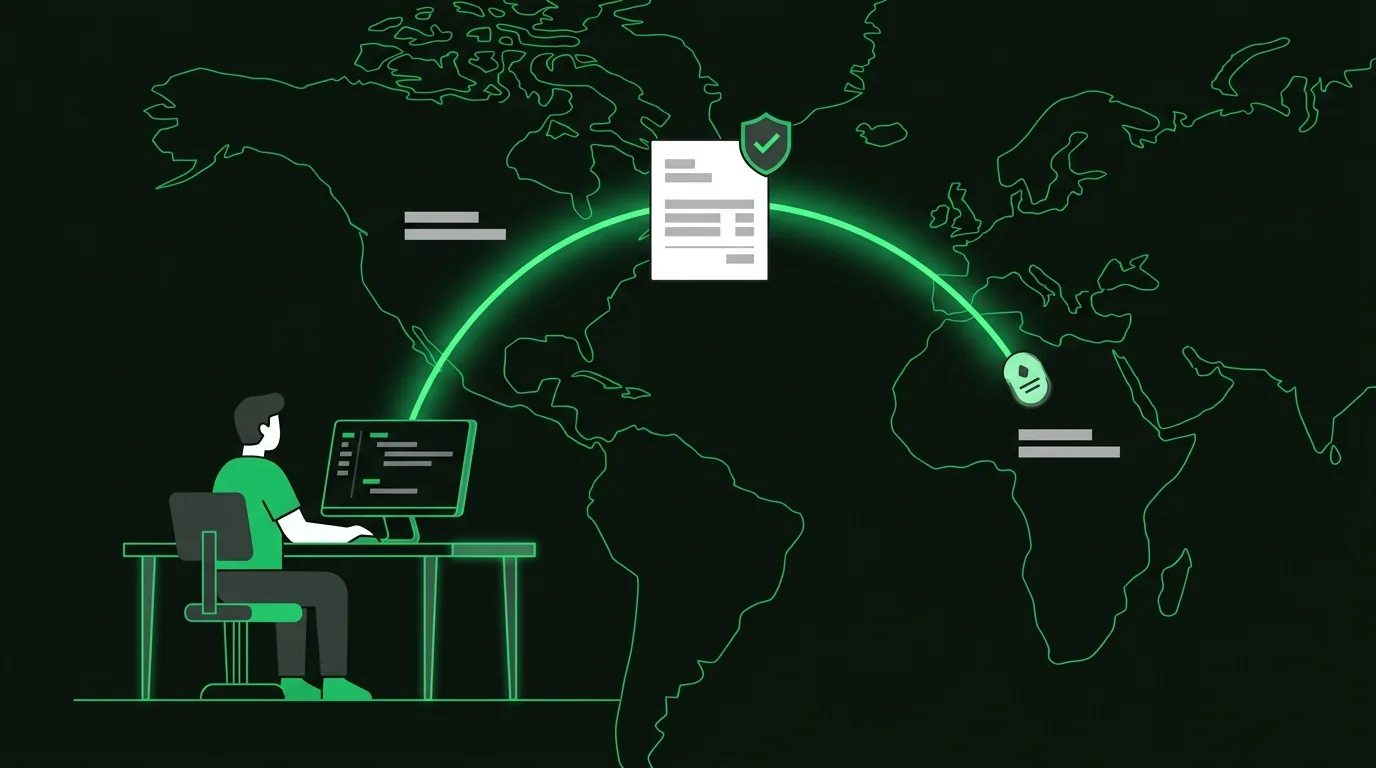
The first time a client in Berlin or Amsterdam asks you to "invoice with reverse charge", it sounds like a setting you forgot to enable. It is not. It is a rule about which country's tax authority gets the money, and it changes exactly one thing on your invoice.
For development work billed to a business in the EU, the usual answer is that you charge no VAT and the client accounts for it themselves. Under the EU place of supply rules, business-to-business services are taxed where the customer is established, so the tax belongs to their country, not yours. Your invoice shows the full fee, a VAT line of zero, your own tax number, the client's VAT identification number, and the words "reverse charge" so their bookkeeper knows why the tax line is empty. That holds whether you are a developer inside the EU billing another member state or a developer outside it billing in. What changes between those two cases is the paperwork behind the invoice, not the amount the client pays.
Everything below is general information for freelance and contract developers, not tax or legal advice. VAT is EU-wide in outline and national in detail, so the exact treatment, the registration thresholds, the penalties and the record-keeping periods all vary by country. Confirm your own position with an accountant licensed where you are established. That is a two-hundred-euro conversation that saves a four-figure mistake.
When does VAT apply to cross-border dev work?
Two questions settle it: is the client a business, and where is that business established.
The European Commission states the general rule plainly on its place of taxation guidance: for supplies of services between businesses, the place of taxation is the place where the customer is established (Article 44 of the VAT Directive). For services from a business to a private consumer, it is the place where the supplier is established (Article 45). Everything else in this article follows from that one split.
Put in terms of the situations a developer actually meets:
| Your situation | Client | Usual VAT treatment |
|---|---|---|
| EU developer, EU client in another member state | Business, valid VAT number | No VAT charged. Client accounts for it under the reverse charge. |
| EU developer, client in your own country | Business | Domestic VAT applies at your national rate. Nothing special here. |
| EU developer, EU client | Private individual | You usually charge VAT at your own country's rate. |
| EU developer, client outside the EU | Business | Usually outside the scope. No EU VAT charged. |
| Non-EU developer (US, UK, anywhere) | EU business | You charge no VAT. The client self-accounts in their country. |
Two of those rows carry caveats worth stating out loud. The Commission's Your Europe guidance on cross-border VAT notes that when you sell services to businesses in another EU country you do not usually need to charge VAT, and the customer pays it at the rate applying in their country through the reverse charge procedure. For private customers you usually charge at your own country's rate, with telecommunications, broadcasting and electronically supplied services as the exception, since those are always taxed in the customer's country. And for customers outside the EU, the same guidance says you usually do not charge VAT, but if the service is used in another EU country, that country can decide to charge it.
UK developers are in the non-EU column now, and HMRC's place of supply of services notice puts it in one sentence: the B2B general rule is that the supply is made where the customer belongs. If that is an EU member state, the supply is outside the scope of UK VAT.
What is the reverse charge in plain English?
The tax does not vanish. It changes hands.
Normally the supplier collects VAT from the customer and hands it to their own tax authority. Under the reverse charge, the supplier collects nothing and the customer does both halves of the transaction on their own VAT return: they declare the VAT they would have paid you as output tax, and in the same breath they reclaim it as input tax. For a fully taxable business, those two entries cancel out and the cash effect is zero. The whole point is to spare foreign suppliers from registering for VAT in every country they invoice.
The mechanism is set out in the Commission's guidance on who is liable to pay VAT. The default is Article 193: VAT is payable by the taxable person making the supply. Article 196 flips it for services supplied to a business by a supplier not established in the customer's EU country, and Article 194 lets member states extend the same treatment more broadly at their own discretion. That last clause is why "check the rules in the client's country" is not lazy advice. The outline is common to the EU. The edges are national.
One consequence developers underestimate: if the reverse charge applies, you do not need a VAT registration in the client's country to bill them. That is the feature. Do not let a client talk you into registering somewhere because their process assumes a local supplier.
What must the invoice say for reverse charge to work?
Four things. That is the entire distinct requirement, and each one has a place on the document.
| # | What the invoice must show | Where it goes | Example wording |
|---|---|---|---|
| 1 | Your own tax identification number | Your identity block, under your address | VAT No. IE1234567AB, or for a non-EU supplier, US EIN 12-3456789 |
| 2 | The client's VAT identification number, with country prefix | The bill-to block, under the client's legal entity name | VAT No. DE123456789 |
| 3 | A VAT line of zero, with the taxable amount shown | The totals block, never omitted | Subtotal EUR 6,400.00 then VAT 0% (reverse charge) EUR 0.00 |
| 4 | The words "reverse charge" | A note line directly under the totals | Reverse charge: VAT to be accounted for by the recipient under Article 196 of Directive 2006/112/EC. |
Rows 1 to 3 come from the mandatory particulars the Commission lists in its VAT invoicing rules: date of issue, a unique sequential number, both parties' full names and addresses, the customer's VAT identification number where the customer is liable for the tax, a description and quantity, the unit price excluding tax, and the VAT rate and amount, broken down by rate or exemption. Row 4 comes from the same page, which says that where the customer is liable for the tax, the invoice must include the words "reverse charge". Not "RC", not "0% export", not a blank cell. The words.
The totals block ends up looking like this:
Subtotal                       EUR 6,400.00
VAT 0% (reverse charge)        EUR     0.00
Total due                      EUR 6,400.00

Reverse charge: VAT to be accounted for by the recipient
under Article 196 of Directive 2006/112/EC.
If you are outside the EU, one honest clarification that most guidance skips. The invoicing rules in the VAT Directive govern invoices issued under an EU member state's rules. A US or Australian sole trader issuing a US-format invoice is not bound by Article 226 the way a Dutch supplier is. But the client's finance team still has to book the transaction, and the reverse charge note is the sentence that tells them how. Including it costs you nothing and removes the most common reason a foreign invoice sits in a queue. Include it. Where you would put a VAT number and have none, write your local tax number and a plain line such as "Not registered for VAT. No establishment in the EU."
Everything else on the document is the same invoice you always send, and the checklist in what belongs on a software development invoice still applies. Reverse charge is an addition, not a replacement.
What do you need from the client before invoicing?
Collect four items at kickoff, not on the day you bill. Chasing a VAT number after an invoice has been rejected is the slowest possible version of this.
- The full legal entity name and registered address. Not the trading name, not your contact's personal details. Multinationals pay from a specific registered entity and the wrong one bounces.
- The VAT identification number, in writing, with its country prefix. The Commission notes that each EU country uses its own format, generally the country code followed by a block of digits or characters.
- A VIES check, dated. Validate the number through the Commission's VIES VAT number validation service and save a screenshot with the date. The tool queries national databases, so a result reflects what that member state's register says at that moment.
- Some evidence the client is in business. HMRC's notice 741A is blunt about what counts: for EU customers, their VAT registration number is the best evidence that the customer is in business. For customers who cannot supply one, certificates from fiscal authorities or other commercial documents indicating the nature of their activities.
If VIES returns invalid, do not assume the client is lying. The Your Europe guidance lists several reasons a number fails: it may not exist, it may not be activated for intra-EU transactions, or the registration may not be complete. It also warns that changes at national level are not always reflected immediately in the databases, and that the Commission cannot accept responsibility for the accuracy of information it draws from registers it does not control. Send the client the failing result and ask them to confirm with their own tax office. Do not invoice zero-rated on a number you could not validate.
Keep the file. The Commission's invoicing page says businesses are generally free to store invoices where and how they like, on paper or electronically, including in a different member state, and that electronic invoices are equivalent to paper ones subject to the recipient accepting them. How long you must keep them is set nationally, so ask your accountant for your own country's period rather than guessing from a blog.
What happens if you get it wrong?
Three failure modes, in ascending order of expense.
You leave the wording off. The invoice arrives with a zero VAT line and no explanation. Someone in accounts payable flags it, emails you, and the payment waits for your reply. Cost: two weeks of your cash flow. Fix: reissue with the note.
You charge VAT you should not have charged. Now the client has paid tax to the wrong country's system and generally cannot reclaim it through their normal return, so they will ask for a credit note and a corrected invoice. Cost: an awkward conversation and a delayed payment. Fix: credit note, reissue, keep both.
You zero-rate something that was not eligible. This is the one that lands on you rather than the client. If the customer turns out not to be a taxable business, or the service falls under one of the exceptions to the general rule, the VAT may be yours to account for, out of a fee you already agreed. Penalties and interest are set by national law and vary. This is exactly the situation the dated VIES check and the written confirmation of business status are there to prevent.
None of that is dramatic if you are consistent. The habits that avoid all three are the same ones that keep the rest of your cross-border billing clean, covered in how to invoice international clients as a developer, and they pair with picking a payment rail that does not eat the margin, compared in Wise vs PayPal for freelancers.
Frequently asked questions
Do US freelancers ever charge EU VAT?
For ordinary custom development work sold to an EU business, no. You are not registered in the EU VAT system and the client self-accounts under the reverse charge. Where it can change is business-to-consumer supplies, because telecommunications, broadcasting and electronically supplied services sold to EU private individuals are taxed in the customer's country regardless of where the supplier sits, and the EU runs a registration scheme for non-EU suppliers in that position. Whether a specific product of yours falls into that category depends on how automated the supply is, which is a question for an accountant and not one to answer from a template.
Where do I find a client's VAT number?
Ask for it in writing during onboarding, alongside the legal entity name. Most EU businesses print it in the footer of their website, on their own invoices, and in their imprint or legal notice page. Once you have it, validate it in VIES and keep the dated result. Do not copy a number off a website and treat that as verification.
What exact sentence goes on a reverse-charge invoice?
The minimum required by EU invoicing rules is the phrase "reverse charge" on the document. In practice, put a full sentence under the totals so nobody has to interpret it: "Reverse charge: VAT to be accounted for by the recipient under Article 196 of Directive 2006/112/EC." If the client issues the invoice on your behalf instead, the same Commission guidance requires the words "self-billing" on that document.
Does this apply to B2C clients too?
No. The reverse charge is a business-to-business mechanism, and it depends on the customer being a taxable person who can account for the VAT. Selling to a private individual in the EU generally means charging VAT at your own country's rate if you are an EU supplier, with the digital-services exception noted above. If a client cannot give you a valid VAT number, treat the sale as consumer-facing until an accountant tells you otherwise.
Once you know the treatment, issuing the invoice takes a minute. The tax field label in billable.dev is editable text: set it to "VAT 0% (reverse charge)", drop the Article 196 sentence into the notes, and generate the PDF. No account, no signup, and the client data never leaves your browser.