 billable.dev
Late Payment Email Templates for Freelance Developers
By Mark Fulton · 2026-08-13 · 13 min read
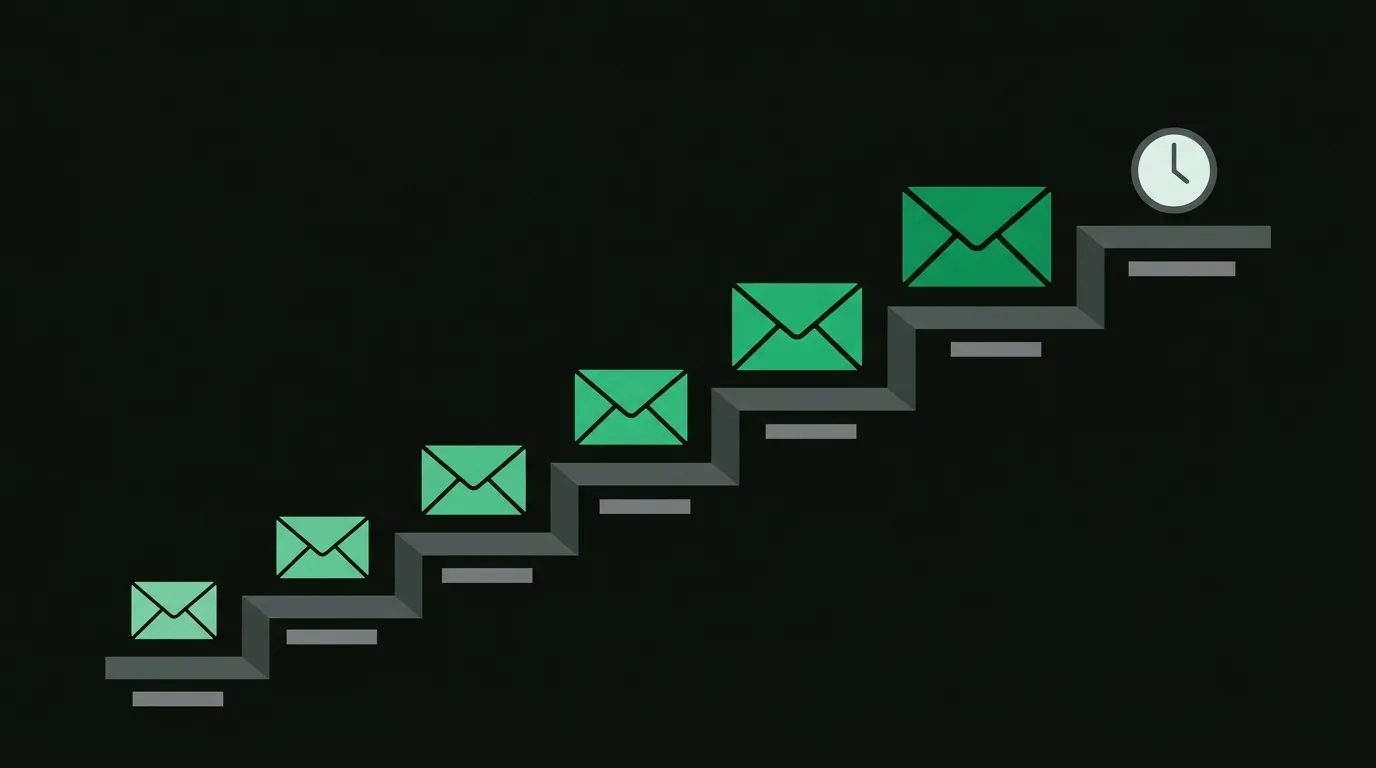
Send six emails, on a schedule, and let each one change exactly one thing. A nudge three days before the due date, a confirmation request on day one, a request for a specific payment date on day seven, an escalation that adds a second recipient and restates your terms on day fourteen, a work-pause notice on day thirty, and a final notice after that. Keep every one of them under 120 words, keep the invoice number and amount in the subject line, and never write a paragraph explaining how you feel about it. The sequence works because it is predictable, not because any single email is persuasive.
Most advice on chasing invoices is written for a business with an accounts-receivable function emailing another business with an accounts-payable function. That's not the situation you're in. You're one developer emailing a founder who approved the work personally, or a project manager at an agency who has no authority over payment runs and no idea why finance hasn't processed it. The words that work in that context are different, and so is the escalation path — because your leverage isn't a collections department, it's the branch you haven't merged and the deploy access you still hold.
What follows is a sequence you write once and reuse for the rest of your career. Change the names, the numbers and the project, and it works on the next one.
When should you send the first reminder?
Before the invoice is late. Not on the due date — three days before it.
This is the single highest-return email in the sequence and almost nobody sends it, because it feels like nagging over money that isn't owed yet. It isn't. It's a systems check. The most common reason an invoice goes unpaid isn't refusal, it's that it never entered the client's payment system: it landed in one person's inbox, that person meant to forward it to finance, and then a sprint happened. A pre-due nudge catches that failure while it's still free to fix.
After that, the schedule matters more than the wording. Here's the full sequence.
| Send | What you're assuming | What changes in this one | Who's on it | |
|---|---|---|---|---|
| 3 days before due | Pre-due nudge | The invoice may not be in their system yet | Nothing — pure logistics check | Your usual contact |
| Day 1 overdue | Confirmation request | It's stuck in an approval queue | You ask for confirmation of receipt | Your usual contact |
| Day 7 | Payment date request | Somebody needs to schedule it | You ask for a specific date, not "soon" | Your usual contact |
| Day 14 | Terms escalation | Your contact can't move it alone | You add a recipient and cite the agreed terms | Contact + finance/AP |
| Day 30 | Work-pause notice | The delay is now a decision, not an accident | Your work stops until it settles | Contact + finance + whoever owns the budget |
| Day 45+ | Final notice | Direct requests have been exhausted | You name a deadline and what happens after it | Everyone above, plus the signatory |
Two things about this table are deliberate. First, escalation happens on the calendar, not on your mood — you don't wait until you're annoyed, which is what most freelancers do and it's why their day-7 email accidentally reads like a day-30 email. Second, each step adds exactly one new element. If every email escalates on tone, urgency, recipients and consequences simultaneously, you burn the whole ladder in two rungs and have nowhere left to go.
Adjust the day counts to your terms. On net 7 everything compresses; on net 30 with an enterprise client, the day-7 email is often genuinely premature and you'd start the ladder at day 14. What doesn't change is the order.
What do you say before the invoice is even late?
Nothing about payment. You say: here is the document again, and here is my offer to fix anything that would block it.
Subject: INV-0042 due Friday — anything you need from me?

Hi Dana,

Quick heads-up that INV-0042 ($4,200) is due this Friday,
15 August. Attaching the PDF again so it isn't buried in the
thread.

If it needs a PO number, a different billing entity, or a
re-send straight to accounts payable, tell me and I'll turn it
around today.

Thanks,
Mark
Sixty words, no tension, and it does three jobs. It re-delivers the invoice without making anyone search the thread. It puts the due date in front of a human being who may not have looked at it. And by listing the three things that most often block approval — missing PO number, wrong legal entity, wrong recipient — it invites the objection early, when it costs you a day instead of three weeks.
That last point is worth dwelling on. A large share of "late" invoices are actually rejected invoices that nobody bothered to tell you about. If the entity name on your invoice is the client's trading name rather than the registered company that holds the purchase order, an AP clerk will bounce it and it will die silently. Getting the details right the first time is a whole discipline of its own, covered in what belongs on a software development invoice.
How do you escalate at 7, 14, and 30 days?
Start on day one, with an email that assumes competence rather than avoidance.
Subject: INV-0042 ($4,200) — came due yesterday

Hi Dana,

INV-0042 came due yesterday and I don't have confirmation it
landed. No drama — usually this means it's sitting in an
approval queue.

Could you confirm it reached accounts payable, and let me know
roughly when it's scheduled to go out? PDF attached again.

Thanks,
Mark
"No drama" is doing real work there. You have no information yet, and the fastest way to make a payment slower is to imply bad faith to the person who has to advocate for you internally.
Day seven changes one thing: you stop asking whether it arrived and start asking when it will be paid.
Subject: INV-0042 — 7 days overdue, need a payment date

Hi Dana,

INV-0042 ($4,200) is a week past due and I still don't have a
payment date.

Two things would help:

1. Confirm the invoice reached accounts payable.
2. Tell me the date it's scheduled to be paid.

If something on the invoice is blocking approval — PO number,
entity name, a line item someone's querying — tell me what it
is and I'll fix it today.

Thanks,
Mark
The numbered list is there because a vague reply is the enemy. "I'll chase it" costs your contact nothing and buys them another two weeks. A date is a commitment you can hold them to, and if the date passes you have a much stronger next email than "just following up."
Day fourteen adds a second recipient and your contractual terms. This is the first email that stops being a favour between two people and starts being a business matter.
Subject: INV-0042 — 14 days overdue

Hi Dana,

INV-0042 ($4,200) is two weeks past due under the net 14 terms
in our agreement, and I don't have a payment date.

Copying Priya in accounts payable so this stops depending on a
single inbox.

Our terms provide for interest on overdue balances. I'd rather
not apply it, so I'll hold off until 29 August — I just need a
firm date before then.

Can you send one?

Thanks,
Mark
Day thirty is where the sequence stops being about the email and starts being about what you do. Nothing you can write is more effective than the sentence in the second paragraph here.
Subject: INV-0042 — 30 days overdue, pausing work on checkout

Hi Dana,

INV-0042 ($4,200) is 30 days overdue. After three requests I
still have no payment date, so I'm pausing work on the checkout
migration from today. Everything merged so far stays in the
repo — nothing is being withheld or reverted.

I'll pick the next milestone straight back up the day the
invoice settles. No restart fee, no renegotiation.

If there's a problem with the invoice itself, I'd genuinely
rather hear it than keep guessing.

Mark
Three details make this land instead of detonating. You pause forward work rather than removing anything already delivered, which keeps you on the right side of your contract and your own professionalism. You state the resumption condition and price it at zero, so the client's path back is obvious and cheap. And you leave the door open for a dispute you haven't heard about, because occasionally the reason is real and nobody told you.
Pausing work also converts the problem. An unpaid invoice is your problem; a stalled roadmap is your client's problem, and it's the one their manager asks about on Monday.
When do you mention the late fee?
At day fourteen, once, as a fact — and then stop talking about it.
Mentioning a late fee in your day-one email reads as hostility over an invoice that's probably just queued. Mentioning it at every step turns it into noise. Mentioning it once, at the point where the delay stops being explicable, gives it weight.
Word it as a term that exists rather than a threat you're issuing. "Our terms provide for interest on overdue balances, and I'd rather not apply it" is a sentence about your contract. "I will be forced to charge you interest" is a sentence about your feelings. The first one gets forwarded to finance; the second one gets forwarded to nobody.
If you invoice a UK or EU business, you may have more than a contract term behind you. UK guidance on late commercial payments states that where no payment date is agreed, payment is late 30 days after the customer receives the invoice or you deliver the service, whichever is later, and that agreed terms are usually expected to be within 60 days for business-to-business transactions and 30 days for public authorities. For interest, the published rate for charging statutory interest on a commercial debt is 8% plus the Bank of England base rate. Rules and rates differ by jurisdiction, and the US has no federal equivalent, so check your own position before you quote anything in an email. The full picture of terms, deposits and late-fee clauses — the things that prevent this sequence from being needed at all — is in getting paid on time with net terms, deposits and late fees.
Here's the honest part: most freelancers who have a late-fee clause never collect on it, and it still works. Its job is to change where your invoice sorts in someone else's payment queue.
When do you stop emailing and change tactics?
When two consecutive emails have gone unanswered and a promised payment date has passed. At that point you're not in a communication problem, you're in a collection problem, and more emails of the same kind will not fix it.
Send one final notice — a different document to everything above. It's dated, it's factual, it lists the previous contacts, and it names a deadline with a stated consequence.
Subject: Final notice before recovery — INV-0042, $4,200

Dana,

Final notice on INV-0042, dated 15 July, for $4,200, now 45
days overdue. Previous reminders: 12 July, 16 July, 22 July,
29 July, 14 August.

Unless payment reaches the account below by 5pm on 5 September,
I will pass this debt to a recovery agent and add interest and
recovery costs to the balance.

I would still prefer to settle it directly, and a payment plan
is on the table if cash flow is the issue.

Bank details: [account]

Mark Fulton
Note the missing "Hi" and the missing "Thanks." That formatting shift is intentional and every AP department recognises it. Note also that you only write the consequence sentence if you're prepared to follow through — an empty final notice teaches the client that your escalations are theatre, and the next one gets ignored faster.
After the final notice, the realistic options are a solicitor's or attorney's letter of demand, a small claims filing, or a collections agency. Which one makes sense depends entirely on the amount and your jurisdiction, and all three are worth an hour of professional advice before you commit. Be aware that the specific consumer-debt-collection rules you may have read about generally govern third-party collectors pursuing personal or household debts, not a business chasing its own commercial invoice — but that's a jurisdictional question, not a universal one.
There's also the option nobody enjoys: writing it off. If you go that way, understand the tax position before you assume there's a consolation prize. IRS guidance on bad debt deductions states that you may deduct business bad debts "only if the amount you were owed is included in your gross income," and that cash-method taxpayers — most sole traders and freelancers — generally can't take a bad debt deduction for unpaid fees. If you never recorded the money as income, there is nothing to deduct. Check with an accountant in your own country before planning around it.
Two structural changes are worth making immediately after any invoice reaches day 30, whether or not it gets paid:
- Shorten the terms for that client. Net 7, or milestone-based with payment before the next milestone starts. A client who paid at day 45 on net 30 is a client whose real payment behaviour you now know.
- Take a deposit next time. Not as punishment — as the version of this problem that resolves before it starts.
And keep the evidence tidy while you're chasing. Disputes about what was delivered are far more common than disputes about whether payment is owed, and the fastest way to end one is a line-itemised invoice you can defend. If you build invoice line items from your git log, that evidence assembles itself out of work you already committed and timestamped.
FAQ
What subject line gets an overdue invoice paid?
The invoice number, the amount and the status, in that order — INV-0042 ($4,200) — 7 days overdue. It looks blunt and that's the point. AP inboxes are triaged by scanning subject lines, and yours needs to be searchable, matchable against a ledger, and unambiguous about state. Avoid "Just checking in," "Quick question," and anything with the word "friendly" in it: they're all indistinguishable from the forty other emails that person is ignoring today. One useful habit is to keep the invoice number identical across the whole thread so every message about it is one search away.
How many reminders should I send before escalating?
Three before you change the shape of the escalation, which in the sequence above means day 1, day 7 and day 14. If none of those produces a specific payment date, more emails to the same person will not produce one either — the constraint is elsewhere. That's when you widen the recipient list, and then when you change what you do rather than what you send. Six emails total is the right ceiling for a normal commercial invoice. If you're on your ninth polite reminder, the sequence stopped working around the fourth.
Should I CC anyone on a payment reminder?
Yes, from around day 14, and pick carefully. Accounts payable is the right first addition, because they're usually the people who can actually schedule the payment and they have no emotional stake in the delay. Your day-30 email is where the budget owner belongs — the person who signed the statement of work. Two rules: never CC someone senior in the first two emails, because you'll burn the relationship with your day-to-day contact for no gain, and never CC someone without saying in the email that you've done it and why. Silent CCs get discovered, and they change the relationship permanently.
Can I pause work over an unpaid invoice?
Usually yes, and it's the most effective single move in the sequence — but check your contract first, because some agreements include a "continue working during disputes" clause or a notice period before suspension. Where you're free to do it, pause forward work only. Don't revoke access, don't revert merged commits, don't take down anything running in production. Give notice in writing, state exactly what resuming costs (ideally nothing), and follow through. Deleting or withholding delivered work is a different act with different legal consequences, and it converts a payment dispute into a much worse conversation.
Sources
- GOV.UK, When a payment becomes late
- GOV.UK, Charging interest on a commercial debt
- IRS, Topic no. 453, Bad debt deduction
Reminders work better when there's nothing on the invoice to argue with. Generate a clean invoice free at billable.dev — sequential numbering, real due dates, your terms on the document, no account needed, and nothing leaves your browser. Pro ($4/mo billed as $24 every 6 months, or $79 once) adds saved clients and invoice history if you want a record of what you sent and when.
This post is general information, not legal or tax advice. Statutory payment rules, interest entitlements and debt-recovery options vary by country and by state, and tax treatment of unpaid invoices depends on your accounting method. Check your own position before relying on any of it.